
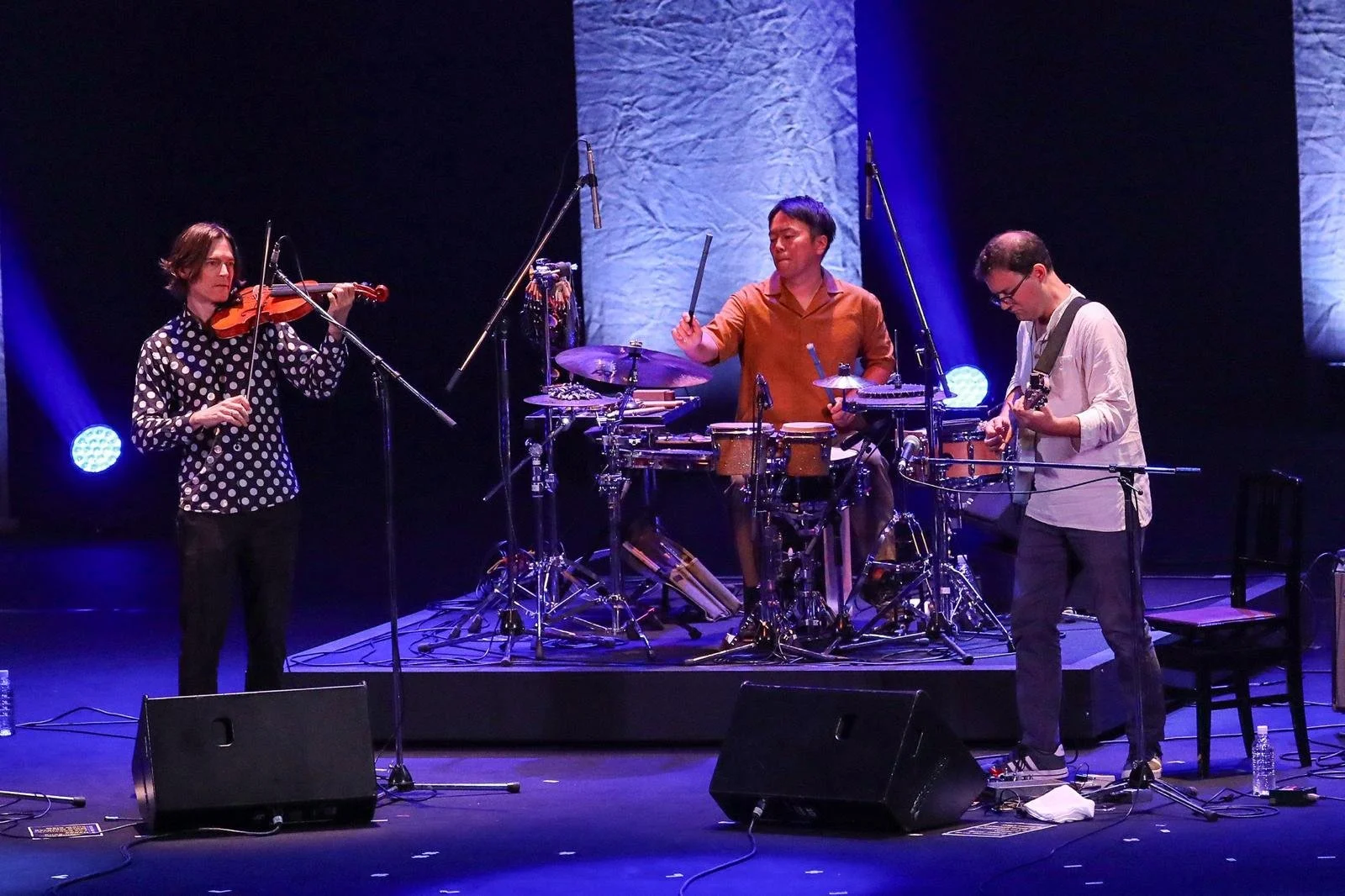
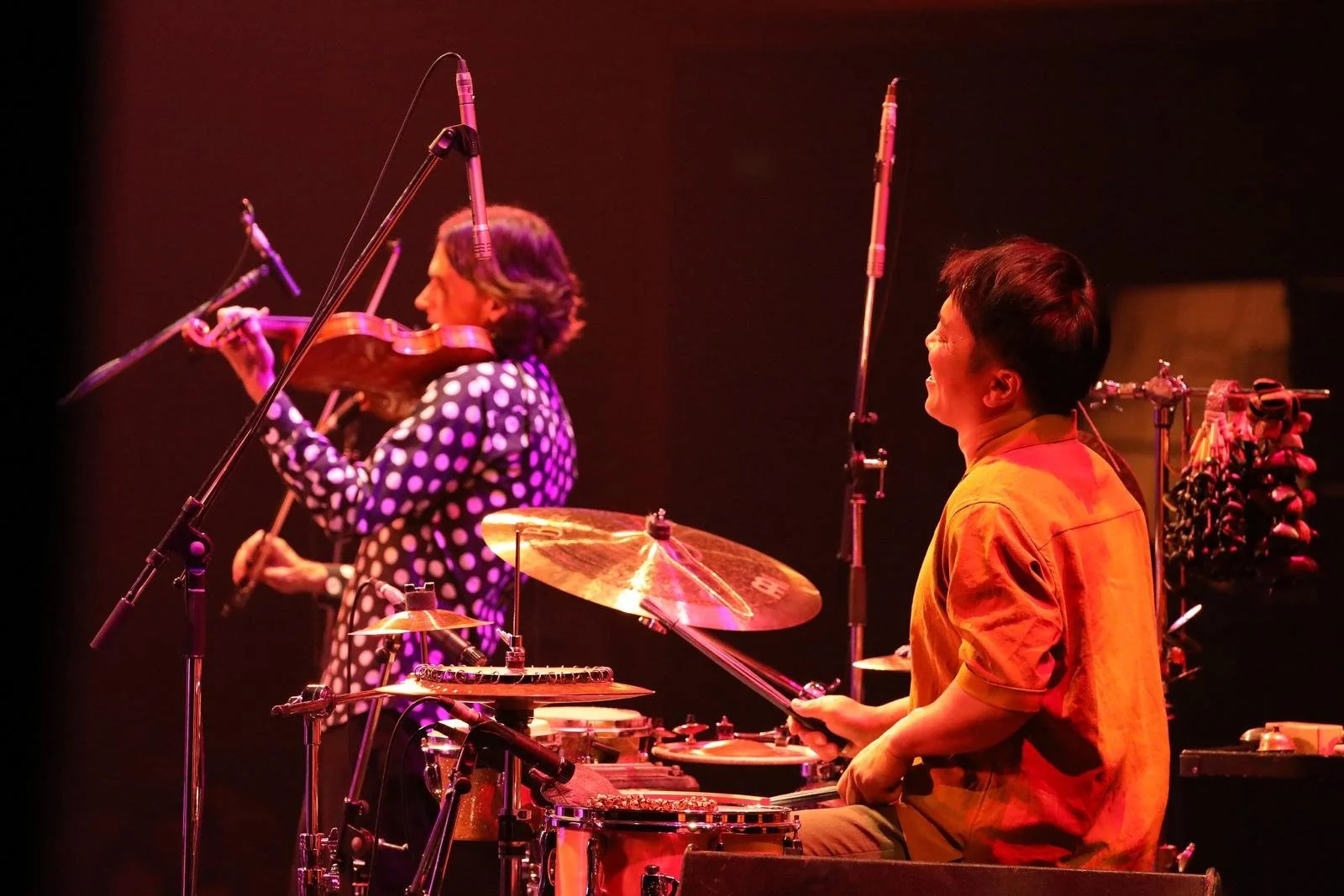
New videos of Zach w/ Stanley Clarke Band, 3/17 & 18, 2009

April 15th, 2009


Zach%20Brock
Quantcast

PARTY OF TWO @ BEAST: LIVE JAZZ IN THE BACK ROOM

February 6th, 2009

PARTY OF TWO @ BEAST: LIVE JAZZ IN THE BACK ROOM

PRESS RELEASE
PARTY OF TWO @ BEAST: LIVE JAZZ IN THE BACK ROOM

Jazz violinist Zach Brock will appear in performance with guitarists Jonathan Kreisberg, Ben Monder, and Nate Radley at Beast Restaurant, located at 638 Bergen Street in Brooklyn’s Prospect Heights neighborhood at 8PM on February 16, 23, and March 2 respectively.  There is no cover charge or drink minimum and seating is limitedCall 718-399-6855 to make a reservation.

About Zach Brock:  Zach Brock has been heralded by Blue Note artist and MacArthur Grant recipient Patricia Barber as “the one on whom to place your bets in jazz” and lionized as “the great bright hope for jazz violin” by the Chicago Tribune.  Brock’s first band, The Coffee Achievers, progressed from a circuit of Midwest jazz clubs to Carnegie Hall and the Tudo e Jazz Festival in Brazil. They also produced three recordings on Brock’s own label, Secret Fort Records.  Brock has performed with an impressive roster of artists including Stanley Clarke, Patricia Barber, and Bob Dorough, as well as Alice Coltrane, George Cables, Jeff “Tain” Watts, Kurt Elling, Dennis Chambers, John McLean, Grazyna Auguscik, The Mahavishnu Project and Eastern Blok.  In 2009 Brock will make his international film debut as part of “Passion,” a documentary about forgotten jazz violin pioneer Zbigniew Seifert.

February 16, Jonathan Kreisberg: Jonathan started playing guitar at the age of ten. At 16 he was admitted to the New World School of the Arts in Miami, where his jazz studies took center stage.  Intensely dedicated to the instrument, he was featured in Guitar Player and DownBeat while still in his teens.  He won a scholarship to the University of Miami, where he held the guitar chair in the acclaimed Concert Jazz Band, touring Brazil and performing with Joe Henderson, Michael Brecker, and Red Rodney.  In Miami he also performed with the New World Symphony under Michael Tilson Thomas. Since returning to New York City in 1997, Jonathan has worked in the bands of many greats including Joe Locke, Dr. Lonnie Smith, Joel Frahm, Greg Tardy, Roy Nathanson, Donald Edwards, Jane Monheit, Ari Hoenig, Yosvany Terry, and Lenny White.  He has also led groups of various instrumentations featuring artists such as Bill Stewart, Larry Grenadier, and Scott Wendholt.  He has recorded five CDs as a leader, including Unearth (2005), his first release on Mel Bay Records.

February 23, Ben Monder: A musician in the New York area for 25 years, Ben Monder has performed with a variety of artists, including Jack McDuff, Marc Johnson, Lee Konitz, George Garzone, Tim Berne, and Kenny Wheeler. He is a regular member of the Maria Schneider Jazz Orchestra and the Paul Motian Octet, as well as many other projects. He has conducted clinics and workshops around the world, and served on the faculty of the New England Conservatory from 2002-2005. Ben continues to perform original music internationally with his own quartet, trio, and in a duo project with vocalist Theo Bleckmann. He has appeared on over 100 CDs as a sideman, and has released 4 as a leader: Oceana (Sunnyside, 2005), Excavation (Arabesque, 2000), Dust (Arabesque, 1997), and Flux (Songlines,1995).

March 2, Nate Radley: Nate Radley was born in Concord, NH and studied music at New England Conservatory, in Boston, MA.  He has recorded and performed with a variety of jazz artists including Rick Margitza, Mark Turner, Donny McCaslin, Greg Osby, Chris Potter, John Hollenbeck, Billy Hart, Seamus Blake, Cuong Vu, Matt Wilson, Antonio Sanchez and George Garzone. Nate has performed throughout the United States, Canada, and Europe, at jazz festivals including the North Sea Jazz Festival and the Montreal International Jazz Festival, and can be heard on recordings for the Steeplechase and Fresh Sound/New Talent record labels. In 2005, Nate was named one of the winners of the ASCAP young jazz composers competition. He currently leads his own trio, and performs with a variety of bands based in New York.

About Beast Restaurant: Beast opened its curved, medieval-looking doors in February of 2005, offering a non-traditional, American spin on Mediterranean tapas, served up in a unique atmosphere. Since its opening in 2005, Beast has won acclaim, particularly for its unique menu, including a Top Pick in The New York Times, inclusion in the Top 5 Brunch Spots in New York City from New York Magazine, and was nominated in the Reader’s Choice Awards for Best New Brooklyn Restaurant in Time Out New York.  Go to www.brooklynbeast.com for more information.

The Real Jazz Age Is Now

December 11th, 2008

We’re all bracing for the worst in 2009 as the world’s economies slide into uncertainty, and violence seems to be the only renewable resource that is being developed. As you read this, I hope you haven’t lost your job or your retirement funds or a loved one. It’s happening all around us, yet we’re still being bombarded with messages that don’t seem to reflect the real conditions on the ground. The most significant and historic presidential election since George Washington happened only five weeks ago. Yet, we’ve been freshly demoralized by more Wall Street felonies, allegations of corrupt governorships selling Senate seats, auto industry executives crying “no fair,” and another horrific international terrorist incident. As an antidote to our current situation, here is a reason to be elated, inspired, relieved and thankful during this holiday season: Jazz music is saving the world.

Since Jazz music has become so marginalized in today’s media and culture, I’m not surprised to have noticed a glaring lack of commentary referring to its undeniable and significant contributions to this historic moment. Of course, the contributions to which I refer include championing social equality and tearing up the roots of racism, but the method of this social revolution is what I’m more preoccupied with. Jazz music’s thesis would indicate that this election is not so much a momentary triumph of justice over injustice as it is the long-awaited arrival at an inevitable destination.

Several years ago I participated in a concert and lecture series called “The Jazz Age In Paris.” I must confess that until I was under deadline to submit a written proposal I hadn’t done much scholarly research on this era. The Wikipedia entry, while lacking in many respects, can provide the gist of what some scholars say concerning this topic. By definition, it was the first time in history that the rest of the world, in a mainstream sense, was introduced to American Jazz.

People were in a state of shock after WWI. The aftermath of a new, 20th century-style mechanization of mass slaughter (i.e., land mines, chemical warfare, tanks, and air assaults) following a seemingly isolated terrorist incident had shaken many people’s belief in humanity and had laid waste to the romantic aesthetics of the last century: enter Schoenberg, Ives, Ernst, Picasso, Stein, Joyce, etc. While the old-world racism, sexism, and homophobia of European and American culture were very much in full effect, there was also a palpable sense that “what once was, is no longer.” Seem familiar?

It is easy to cast aspersions on the world’s fascination with the “exoticism (code word)” of American Jazz, but regardless of unrighteous motivations, Jazz also became the dominant “pop culture” theme around the world. People were responding to a new social openness that wasn’t welcomed at the opera, museum, university, or church. People were also responding to a new musical style that combined the well-known with the unknown; both rebellious and nostalgic.

Since then, Jazz has been in everyone’s lives, woven into the fabric of American (and international) culture, actively and indiscriminately assimilating every other form of music that it encounters. It has provided a universal context for its practitioners and enthusiasts to work together, relate to one another, and to express things with one another that go beyond one’s individual background.  Jazz is an antidote to beliefs that assert an intrinsic superiority as their claim to power, and it is a paragon of cultural inclusion.

I am in no way implying that people practicing and admiring Jazz were somehow sheltered from the ills of society or that, within the jazz community itself, people have existed in an egalitarian, multi-cultural utopia. It’s too easy to conjure the images of Miles Davis holding a handkerchief to his bloodied head after being assaulted by a cop outside one of his own gigs, or to recall the domestic terrorism that set the precedent for John Coltrane’s “Alabama,” or, years earlier, the sickening reality conveyed by the lyrics of Billie Holiday’s “Strange Fruit.”

What I am saying is that the “Jazz method” of reconstituting other forms of music to suit its own ideals has been mirrored by our society.  Jazz music, in fact, is the artistic embodiment of our society.  The election of Barack Obama confirms a human trend towards improving and evolving beyond the limits of the past and is a much-needed reminder that we may aspire to our ideals. I hope, in the face of everything to come in 2009, that we can remember the inspired things of which we are capable. The Jazz Age may have dawned in 1918, but it just broke the horizon in 2008, and there is much music to be made.

Change We Can Believe In

October 14th, 2008

Vote for Barack Obama!

From the Chicago Tribune – Friday, March 7, 2008

March 7th, 2008

MEET THE GREAT BRIGHT HOPE FOR JAZZ VIOLIN

By Howard Reich, Chicago Tribune Critic

March 7, 2008


Great jazz violinists always have been in perilously short supply, which may explain why many listeners have been investing their hopes in the work of Zach Brock.

For more than a decade, Brock was ubiquitous on Chicago’s club and concert landscape, collaborating with everyone from trumpeter Orbert Davis to saxophonist Von Freeman to conductor William Russo and the Chicago Jazz Ensemble.

Though Brock moved to Brooklyn two years ago, he has performed here so often since that his show this weekend at the Green Mill Jazz Club can’t precisely be called a homecoming. Instead, it’s just the latest page in the gifted violinist’s enduring romance with Chicago — and Chicago jazz.

“For me, Chicago did everything,” says Brock, who was born in Lexington, Ky., and moved here in 1992 to attend Northwestern University’s School of Music.”

Chicago was a really, really great place to be in a jazz environment of the highest order, with the greatest players. The older players were very generous with their time and knowledge … and I met these amazing musicians my age and younger.”

The vitality of the scene certainly honed Brock’s art, which combines the technical rigor of his classical training with the spirit of experimentation that long has been integral to the best Chicago jazz. Whether fronting his edgy — and appropriately named — Coffee Achievers band or playing high-flown phrases in Duke Ellington’s “Black, Brown and Beige” with the Jazz Ensemble, Brock has combined the best of two worlds: instrumental virtuosity and creative improvisation.

More important, he has done so on the violin, an instrument that historically has been marginalized in jazz.

Granted, that jazz-fiddle world has produced key players. The honor roll spans early-20th Century pioneers such as Stephane Grappelli, Joe Venuti and Eddie South; plugged-in adventurers such as Jean-Luc Ponty and Didier Lockwood; unrepentant avant-gardists such as Leroy Jenkins, Billy Bang and Ornette Coleman; and modern-day mainstream players such as Regina Carter.

Yet in the second half of the 20th Century, particularly, the violin has been practically a novelty in jazz.So Brock’s emergence holds great promise. Having appeared on nearly two dozen CDs as leader and sideman, he appears poised for a stylistically wide-ranging career.

Certainly critics have noted the strengths of his work.

“Brock has a rich, often deep, tone,” noted Richard Kamins in the Hartford Courant. He “explodes with furious fiddling,” observed Jerome Wilson, in Cadence. “Brock can wail, worry and screech like Jean-Luc Ponty,” noted Wilson, in another review.

For Brock’s Green Mill date, he will present his most daring project to date: his Arrival/Departure band, which champions the groundbreaking music of the nearly forgotten Polish jazz violinist Zbigniew Seifert. Having discovered Seifert’s recording “Passion” several years ago at Chicago’s Jazz Record Mart, Brock eventually became fascinated with the music and the man, who died in 1979 at age 32.

Seifert essentially absorbed the innovations of John Coltrane and pushed beyond them, taking the violin into freshly contemporary techniques, says Brock. He’ll be playing Seifert’s music, as well as his own, with such formidable artists as guitarist McLean and singer Grazyna Auguscik.

Brock also is working on a documentary film about Seifert — “Passion,” which is being directed by his fiance, Erin Harper.”

Zbigniew was really coming from somewhere totally different; he was completely original,” says Brock.

Thank you to Seattle and San Diego!

February 10th, 2008

Zach Brock, Stanley Clarke, and Dennis Chambers

Discovering Zbigniew Seifert, pt. 1

January 5th, 2008

A few weeks ago, as I was searching my computer for Zbiggy-related documents, I happened across a three-year-old essay that I had written for academic purposes. Much of the essay shows how little I really knew about Zbiggy and his music at the time. I think, however, that it accurately represents the events leading up to and immediately following my personal discovery of his music. I am sharing parts of this essay with the intention of starting a conversation about Zbiggy that I hope will develop throughout the year and continue far beyond. I hope that you enjoy learning about the music of Zbigniew Seifert as much as I have.Polish jazz violinist and composer Zbigniew Seifert (June 1946 – February 1979) was, after Jean-Luc Ponty (September 1942-), the most radically groundbreaking violinist in the history of modern jazz. Since the late nineteen sixties, many improvising violinists have become conversant in the language of bebop, funk, jazz-rock, blues-rock, and the avant-garde. However, the post-Coltrane language, harmony, and nuance that Seifert explored remains largely uncharted territory on the violin. While re-mastered recordings of all the major (and some minor) jazz violinists abound, Zbigniew Seifert retains the unenviable distinction of being the most obscured violinist of his importance.

Seifert, who during his brief career recorded five times as a leader (two times for Capitol Records) and well over thirty sessions as a sideman, is completely out-of-print. Celebrated as an important jazz pioneer in Poland and the rest of Europe, Seifert is virtually unknown to jazz fans and musicians in the United States. Why nothing until now has been done to remedy this fact remains somewhat of a mystery. It is a more complicated situation than one might initially posit and it is one that requires diligent work and cooperation if we are to accomplish the re-mastering of his seminal works before it is too late. The magnetic tape recordings made in the early and mid-seventies are already showing rapid signs of deterioration and we may lose the ability to restore Seifert’s work to the level it deserves if more time is lost.

I became aware of Zbigniew Seifert through a Verve sampler CD called “Jazz Club Violin.” Seifert’s inclusion, a track called “Stillness”, featured him in duet with bassist Cecil McBee. Although I immediately recognized Seifert as a strong individual voice, I was in a developmental phase (i.e. young and stupid) where I only paid attention to violinists who were playing bebop lines. When I wasn’t listening to horn players, pianists, guitar players, or any other instrument other than the violin, I followed the recordings of the young Jean-Luc Ponty and, later, Didier Lockwood. The second time I heard the name Zbigniew Seifert was from the pianist Dave Kikoski. Kikoski was playing in Chicago with Roy Haynes and the band had gone to saxophonist Von Freeman’s famous jam session after the show. I approached Kikoski to ask him about a Didier Lockwood recording he had played on called “New York Rendezvous.” We began talking about other violinists who were playing in a more modern style and he quickly steered the conversation to “Zbiggy.” He informed me that other New York-based jazz musicians such as Richie Beirach and David Liebman had told him about playing with Seifert in the 1970’s and he insisted that I find more recordings. The conversation made such an impression on me that I began looking for Seifert records the next day. However, after looking in every record store in Chicago and scouring the Internet for hours, I gave up.

About a month later, while playing a CD release show at a local jazz record store, I stumbled across Seifert’s posthumous recording “Passion” in the used record bin. The lineup of Richie Beirach, Eddie Gomez, Jack DeJohnette, Nana Vascocelos and John Scofield was sufficient to peak my interest once again. Written on the back of the record was the first bit of biographical information that I had found outside of the conversation with Kikoski: Polish-born Zbigniew Seifert died in Buffalo, NY in 1979 at the age 32 while undergoing experimental surgery for cancer. Fortunately, the overcast introduction was obliterated by the music that leapt off of the record and out of my stereo speakers. What I heard in that moment did as much as anything I had ever previously heard to alter my view of music, life, and all its possibilities. Seifert’s voice was unusually powerful, emotive, and compelling. The musical phrases and lines that he played were seemingly devoid of the usual “violin licks” that prevailed in so many other jazz violinists’ vocabulary. At the same time, and most importantly, his playing was much more than impressive or inspiring to me; it was deeply moving.

Since making that first discovery I have acquired all of the albums that he recorded as a leader. Everything that this amazing musician ever did, with the exception of an album called “Violin” by the band Oregon, remains completely out-of-print in this country. I found the remainder of his discography through a German record collector and generous donations from other Zbiggy-philes. What I have since discovered in these other recordings begins to form the picture of a creative statement that rivals or exceeds all that has occurred in jazz violin since the early 1970s. With hard work and luck, we should be able to re-light the torch that Zbigniew carried and to find others that are willing to carry it into the future. It is certainly a worthwhile endeavor and it is also certainly one that will give back far more in return.


Check out the new trailer for Passion

December 12th, 2007

After almost three weeks of interviews and concerts shot this past October in Poland, Germany, and Austria, the new trailer for “Passion” is available for your viewing pleasure atwww.passion-themovie.com. The movie, directed by Erin Harper, is a documentary about the journey to illuminate the lost legacy and music of Zbigniew Seifert. Seifert, arguably the most important modern jazz violinist since Jean-Luc Ponty, remains the only violinist to truly absorb the language and harmony of John Coltrane and McCoy Tyner. While Seifert’s musical voice was nothing less than transcendent and his approach to playing the violin was unprecedented, his life was cut short by cancer in 1979 at the age of 32. Now, almost thirty years after his death, despite having made major-label recordings for Capitol and MPS with musicians such as Tomasz StankoJohn ScofieldJack DeJohnetteRichie Beirach, and Billy Hart, Seifert’s entire catalog is out of print. Zach, Erin, and the entire crew (maybe you too?) hope to change this in the next year. Downbeat Magazine will publish a brief article about the movie later this winter. Stay tuned for an essay that will be posted in the Blog section on www.zachbrock.com. The film, which is currently mid-production, is seeking to expand it’s mailing listand is looking for donations. If you or anyone that you know might be interested in making a tax-deductible donation, please go to the IFP Donations page and under “Designate my donation” please specify your donation for “Passion.” ”Passion” is a sponsored project of IFP and The Polish Cultural Institute of New York, and is slated for release in fall ‘08.

 Free Sound

Zach Brock to appear with legendary bassist Stanley Clarke in 2008

December 7th, 2007

Zach will be joining legendary electric bass pioneer Stanley Clarke from January 17-20 at Jazz Alley in Seattle. You can catch the same band for another weekend of shows January 25 & 26 at Anthology in San Diego. Mr. Clarke is touring in support of his new CD “The Toys of Men.” The band includes Ruslan Sirota on keyboards and Ronald Brunner, Jr. on drums. Special thanks goes out to Eric Aceto and Jean-Luc Ponty

Stanley Clarke

2nd Annual Ears & Eyes Festival

December 6th, 2007

As most of you know, Chicago is a happening place. Local bass phenom Matt Ulery has just released his first CD, “Loom”, on Woolgathering Records. Matt composed and arranged all of the music for an unusual ensemble that includes Zach Brock on violin, Thad Franklin on trumpet and flugel horn, Tim Haldeman on tenor sax, Rob Clearfield on accordion and piano,Jon Deitemyer on drums, and Grazyna Auguscik on a guest vocal track. “Loom” is appearing on Sunday, December 9 at an exciting new independent music and film festival called “Ears & Eyes”. The festival, a brainchild of recent Chicago immigre Matthew Golombisky, is an aural and visual experience that brings together local, national, and international talent in music, visual arts, and film

Ears & Eyes Fest

« Previous Entries Next Entries »